
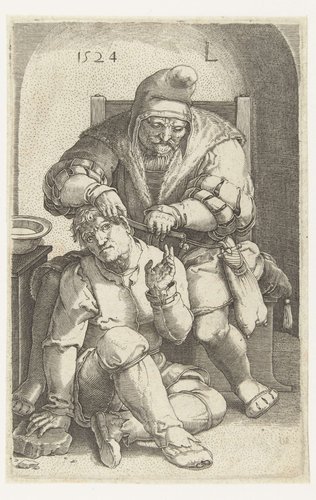
De chirurgijn
1581 - 1628
Medium
engraving
Dimensions
73; 115
Rights
Public Domain
About this artwork
height 115 mm x width 73 mm
Art Historical Context
Jan Harmensz. Muller’s engraving *De chirurgijn* (The Surgeon) exemplifies the refined printmaking tradition of the Northern Netherlands in the late sixteenth and early seventeenth centuries. Working primarily in Haarlem and Amsterdam, Muller was a leading figure among the Dutch Mannerist engravers who translated the dynamic compositions of painters such as Hendrick Goltzius and Bartholomeus Spranger into intricate black-and-white prints. His small-scale works, like this one measuring just 115 by 73 millimeters, were designed for collectors’ albums and scholarly publications, allowing detailed images to circulate widely among physicians, students, and art enthusiasts. The medium of engraving was especially suited to medical and genre subjects during this period. Fine lines could render the precise tools, gestures, and expressions that conveyed both professional skill and human drama. Although the exact composition of *De chirurgijn* remains modest in size, its intimate format invites close inspection, highlighting the surgeon’s instruments and the careful attention to anatomy that characterized early modern scientific imagery. Muller’s prints helped bridge the worlds of art and science at a moment when both fields were rapidly expanding. Today the engraving stands as a charming example of how Dutch printmakers democratized knowledge, turning a single copper plate into hundreds of impressions that educated and delighted viewers across Europe.
About the Artist
Jan Harmensz. Muller · 1571–1628
Comment on works: Printer and Draughtsman