
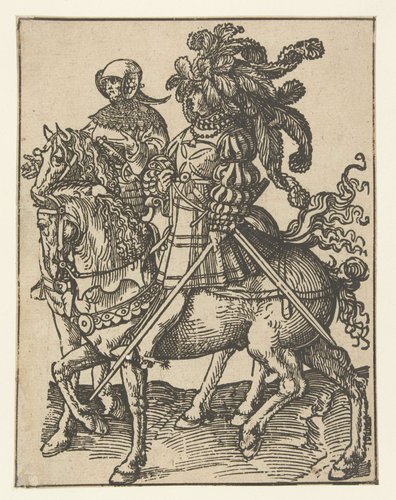
De Graven en Gravinnen van Holland
Medium
paper
Dimensions
172; 134
Rights
Public Domain
About this artwork
houtsnede
Art Historical Context
**De Graven en Gravinnen Holland (The Counts and Countesses Holland)** Created in 1518 by Jacobelisz van Oostsan, a prominent Dutch artist from Haarlem active during the Northern Renaissance, this woodcut measures a modest 172 × 134 mm on paper. Oostsanen, influenced by masters like Albrecht Dürer excelled in printmaking, producing intricate designs that bridged painting and graphic arts. This small-scale work exemplifies his skill in capturing historical nobility, likely as part of a series honoring the ruling lineage of Holland. The title refers to the counts and countesses who shaped medieval Holland, a vital region in the emerging Dutch identity under Habsburg rule. Produced amid the Renaissance's revival of classical and local history, the print served as an accessible visual chronicle, disseminating prestige and heritage to a broader audience beyond elite circles. Such depictions reinforced cultural pride in the Low Countries during a time of political consolidation. As a *houtsnede* (woodcut), the artwork highlights early 16th-century printing techniques: the image was carved in relief on a woodblock, inked, and pressed onto paper, allowing multiple impressions. This method's durability and affordability made it revolutionary for education and propaganda, marking Oostsanen's contribution to the democratization of art in Northern Europe. A charming window into Renaissance print culture!