
De hemelpoort
1708 - 1710
Medium
pen
Dimensions
119; 107
Rights
Public Domain
About this artwork
pen in bruin, penseel in grijs
Art Historical Context
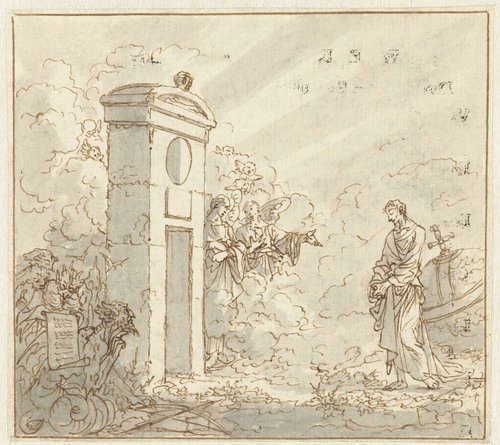
Jan Luyken’s *De hemelpoort* (“The Gate of Heaven”) is a delicate devotional drawing created between 1708 and 1710, near the end of the artist’s life. A prominent Dutch poet, engraver, and illustrator, Luyken turned increasingly toward spiritual subjects after his conversion to a pietistic form of Mennonitism. The small sheet—only 107 × 119 mm—probably served as a design for one of the many religious emblem books or biblical publications that circulated in the early eighteenth-century Netherlands. Executed in brown ink with gray wash, the drawing demonstrates Luyken’s economical yet expressive technique. The combination of fine pen lines and subtle brushwork allowed him to suggest both architectural detail and ethereal atmosphere within a compact format. Such preparatory studies were essential to the production of the engraved illustrations that accompanied devotional texts, making this modest work a key link between private meditation and printed religious culture. Though modest in scale, *De hemelpoort* reflects the deep intertwining of art and faith in Dutch society at the close of the Golden Age. Luyken’s imagery invited viewers to contemplate themes of salvation and divine welcome, offering a quiet yet powerful reminder of the period’s enduring spiritual concerns.
About the Artist
Jan Luyken · 1649–1712
Dutch, Amsterdam 1649–1712 Amsterdam