
De mus schelp
Medium
nishikie, with metallic pigments and tsuyazuri
Dimensions
199; 178
Rights
Public Domain
About this artwork
height 199 mm x width 178 mm
Art Historical Context
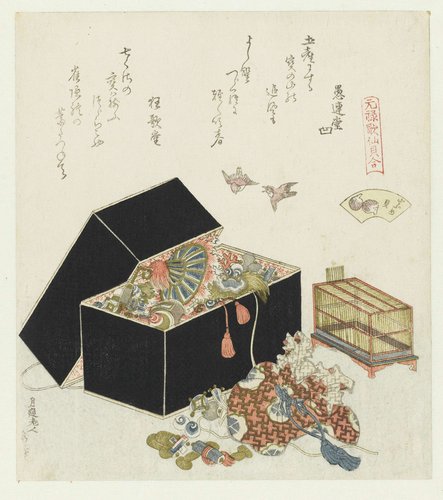
Katsushika Hokus, the legendary Japanese ukiyo-e master1760–1849), created *De mus schelp* 1821 during the Edo period, a time when woodblock printing flourished as an accessible art form for the. Best known for his iconic *The Great Wave off Kanagawa* and theThirty-Six Views of Mount Fuji series, Hokusai produced a compact print measuring just 199 mm high by 178 mm wide— for personal collections or New Year's surimono commissions. The title, translating roughly from Dutch as "The Mouse Shell," evokes Hokusai's playful fascination with nature's whimsy, blending observation with imaginative flair. Rendered in *nishikie* (brocade prints), this work showcases Hokusai's mastery of multilayered woodblock techniques, where vibrant colors were achieved through precise carving and printing from multiple blocks. The addition of metallic pigments and *tsuyazuri*—a shimmering mica effect mimicking dew or gloss—lends a luxurious, jewel-like quality, elevating the humble medium to sculptural depth. These innovations highlighted ukiyo-e's evolution from simple illustrations to sophisticated art, influencing global aesthetics, including Impressionists like Monet. As a snapshot of 19th-century Japanese print culture, *De mus schelp* reflects the era's delight in *yōkai* (supernatural motifs) and natural curiosities, inviting viewers to ponder the shell's form through Hokusai's lens. A gem for any collection, it captures the artist's boundless curiosity at age 61.
About the Artist
Katsushika Hokusai · 1760–1849
Katsushika Hokusai (1760-1849) stands as one of history's most influential artists, a Japanese master who revolutionized the ukiyo-e woodblock print tradition and profoundly shaped Western art. Born in the Katsushika district of Edo (modern-day Tokyo) to an artisan family, Hokusai lived through nearly nine decades of extraordinary creative evolution, adopting over thirty different artistic names t...