
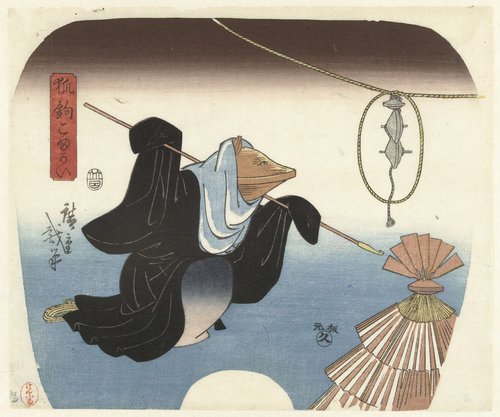
De vossenval
1843 - 1845
Medium
color woodcut
Dimensions
210; 251
Rights
Public Domain
About this artwork
kleurenhoutsnede; lijnblok in zwart met kleurblokken
Art Historical Context
**De Vossenval (The Fox Trap)** *Utagawa Hiroshige I (1797–1858), 1843–1845* *Color woodcut 210 × 251 mm* Utagawa Hiroshige I, a towering figure in Japan's ukiyo-e tradition, crafted *De Vossenval* the mid-19th century Edo period. This intimate color woodcut exemplifies his mastery of the "pictures of the floating world," capturing fleeting moments of nature and folklore. Foxes, revered in Japanese Shinto beliefs as mischievous kitsune spirits, often symbolized cunning and the supernatural—here likely ensnared in a trap, blending everyday rural life with mythic undertones. The print's technique is a hallmark of ukiyo-e innovation: a black line block defines precise contours, followed by multiple color blocks layered for vibrant hues. Created through collaborative craftsmanship—artist, carver, printer, and publisher—this method allowed mass production, democratizing art for urban audiences amid Japan's isolationist sakoku policy. Hiroshige's subtle gradients and atmospheric depth evoke quiet tension, distinguishing his poetic landscapes from bolder contemporaries like Hokusai. As a window into Tenpō-era Japan, *De Vossenval* highlights ukiyo-e's cultural pulse, influencing global modernists like Van Gogh. Its compact scale invites close contemplation, revealing Hiroshige's genius for storytelling in simplicity. (198 words)