
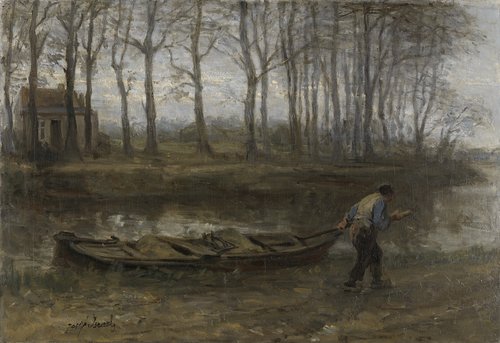
De zandschipper
1887
Medium
oil on canvas
Dimensions
90; 62
Rights
Public Domain
About this artwork
olieverf op doek
Art Historical Context
Jozef Israëls, a leading figure of the Hague School, created *De zandschipper* in 1887 as a sensitive portrayal of everyday Dutch labor. The painting depicts a sand barge worker navigating his vessel, reflecting the artist’s lifelong interest in the quiet dignity of working-class life along the Netherlands’ waterways. Israëls, who often drew inspiration from the coastal communities of his native country, used this modest scene to highlight the strength and resilience of ordinary people. Painted in oil on canvas, the work demonstrates Israëls’ mastery of muted tones and loose brushwork, techniques characteristic of late-nineteenth-century Dutch realism. These methods allowed him to capture both the texture of rippling water and the weathered features of his subject with remarkable empathy. At just 62 by 90 centimeters, the intimate scale invites viewers to connect personally with the solitary figure. Today housed in the Rijksmuseum, *De zandschipper* remains a poignant reminder of the Netherlands’ maritime heritage and the artistic movement that celebrated honest depictions of rural and coastal existence.
About the Artist
Jozef Israëls · 1824–1911
Israëls was born in Groningen to poor Jewish parents. He trained as an artist in Groningen and Amsterdam, and between 1845 and 1855, he expanded his training by travelling to Paris, Dusseldorf, and the artist's colony at Oosterbeek. However, the most influential locations he visited were the Dutch seaside towns of Zandvoort and Katwijk, were he adopted genre painting as a means of documenting the ...