
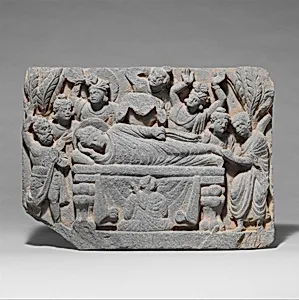
Death of the Buddha (Parinirvana)
Unknown Artist
2nd–3rd century
Medium
Gray schist
Dimensions
H. 11 3/4 in. (29.8 cm); W. 6 3/16 in. (41.1 cm); D. 2 1/4 in. (5.7 cm)
Classification
Sculpture
Culture
Pakistan (ancient region of Gandhara)
Department
Asian Art
Museum
Metropolitan Museum of Art, New York, NY
Credit
Gift of Paul E. Manheim, 1967
Accession Number
67.43.13
Rights
Public Domain
Tags
Art Historical Context
This poignant sculpture, titled *Death of the BuddhaParinirvana)* captures one of Buddhism's most sacred: the Buddha's final passing into nirvana around the 5th century BCE. Carved from gray schist in the ancient Gandhara region of present-day Pakistan during the 2nd–3rd century CE, it measures a compact 11 3/4 inches high. Gandhara art, flourishing under Kushan rule amid Silk Road exchanges, uniquely fused Greco-Roman realism with Indian spiritual iconography, evident in the sculpture's serene, lifelike drapery and expressive forms. The Parinirvana scene symbolizes ultimate enlightenment and impermanence, often depicting the Buddha reclining on his right side amid grieving disciples—a theme central to Buddhist devotion. Crafted in schist, a durable local stone prized for its fine grain, this relief likely adorned a monastery stupa, inviting pilgrims to contemplate mortality and transcendence. Its emotional depth, conveyed through subtle gestures of sorrow, underscores Gandhara's role in popularizing narrative Buddhist imagery across Asia. Now at the Metropolitan Museum of Art (gift of Paul E. Manheim, 1967), this anonymous masterpiece offers a window into early Buddhist artistry, blending classical elegance with profound faith. Visitors are drawn to its quiet power, evoking universal themes of loss and liberation.