
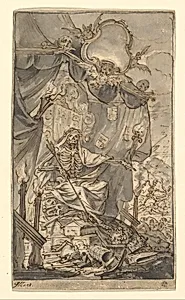
Death on a Canopied Throne (Design for a Title Page)
late 17th century
Medium
Pen and brown ink, brush and gray wash, touches of white gouache, over black chalk. Laid down on heavy paper mount. Incised (?).
Dimensions
6 3/16 x 3 11/16 in. (15.7 x 9.4 cm)
Classification
Drawings
Department
Drawings and Prints
Museum
Metropolitan Museum of Art, New York, NY
Credit
The Elisha Whittelsey Collection, The Elisha Whittelsey Fund, 1960
Accession Number
60.576.14
Rights
Public Domain
Tags
Art Historical Context
In the late 17th century, artist Godfried Maes this striking preparatory drawing, *Death on a Canopied (Design for a Title Page, using pen and brown ink, brush gray wash, touches of gouache over black chalk. Measuring just 6 3/16 x 3 11/16 inches, this intimate—laid down on a heavy paper and possibly incised for transfer—was likely intended as a title page illustration for a book or print, a common practice in Baroque-era Europe where dramatic imagery captured the viewer's attention. The composition centers on Death enthroned beneath a grand canopy, evoking the vanitas tradition popular in Flemish art. Surrounding motifs like skeletons, skulls, and architectural houses symbolize mortality and the fleeting nature of worldly power, reminding viewers of life's impermanence amid opulent settings. Maes, known for his history scenes and meticulous draftsmanship, masterfully layers techniques: the underdrawing in black chalk provides structure, while fluid ink lines, subtle gray washes for depth, and white gouache highlights create eerie luminosity and texture. Housed in the Metropolitan Museum of Art's Elisha Whittelsey Collection (acquired 1960), this work exemplifies the technical virtuosity of 17th-century Northern European drawings, bridging painting and printmaking while delivering a poignant memento mori message that resonates across centuries.
About the Artist
Godfried Maes · 1649–1700
Comment on works: History; Portraits