
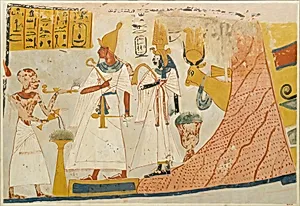
Deceased censing and libating to the deified Mentuhotep and Ahmose-Nefertari, with the Hathor cow emerging from the mountain; Tomb of Ameneminet
1924–1925; original ca. 1295–1170 B.C.
Medium
Tempera on paper
Dimensions
facsimile: h. 60 cm (23 5/8 in); w. 87.5 cm (34 7/16 in) scale 1:1 framed: h. 62.9 cm (24 3/4 in); w. 90.8 cm (35 3/4 in)
Classification
Facsimile, Ameneminet (TT 277), deified Mentuhotep, Hathor cow, desert
Period
New Kingdom, Ramesside
Department
Egyptian Art
Museum
Metropolitan Museum of Art, New York, NY
Credit
Rogers Fund, 1930
Accession Number
30.4.124
Rights
Public Domain
Tags
Art Historical Context
This vibrant facsimile captures a scene from the Tomb of Ameneminet, a New Kingdom official who served during Egypt’s Ramesside period (Dynasties 19–20). Created by artist Charles K. Wilkinson in 1924–1925 using tempera on paper at a precise 1:1 scale, the work reproduces an original wall painting from around 1295–1170 B.C. It shows the tomb owner offering incense and libations to the deified Mentuhotep and Ahmose-Nefertari, while the goddess Hathor appears as a cow emerging from the sacred mountain—symbolizing divine protection and the journey to the afterlife. Such tomb imagery reflects the deep intertwining of religion, kingship, and personal piety in ancient Egyptian culture. The inclusion of deified royals alongside Hathor underscores the belief that pharaohs could intercede for the deceased, while the cow’s emergence from the cliff evokes the Theban landscape and Hathor’s role as a nurturing mother goddess. Wilkinson’s meticulous copies, now in the Metropolitan Museum’s collection, preserve delicate details like hieroglyphs and ritual gestures that remain vulnerable in their original rock-cut settings. These facsimiles allow modern viewers to appreciate the sophisticated color palette and narrative clarity of Ramesside art without traveling to the tombs themselves. The scene’s blend of royal veneration and divine presence offers a glimpse into how Egyptians envisioned eternal life and divine favor.
About the Artist
Charles K. Wilkinson · 1897–1986
Charles K. Wilkinson (1897–1986), born Charles Kyrle Wilkinson in London on October 13, 1897, was the son of Horace W. Wilkinson, a stained-glass window maker, and Frances Adkins. Serving in World War I, he honed his artistic skills at the Slade School of Fine Art, University College London, where the influential director Henry Tonks shaped the rigorous training of a generation of draughtsmen. In ...