
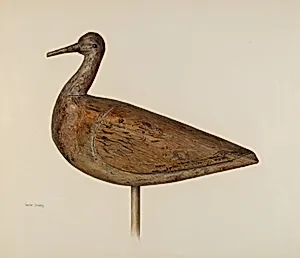
Decoy
c. 1942
Medium
watercolor with white heightening over graphite on paperboard
Dimensions
overall: 35.7 x 40.9 cm (14 1/16 x 16 1/8 in.)
Classification
Index of American Design
Department
CG-W
Museum
National Gallery of Art, Washington, D.C.
Credit
Index of American Design
Accession Number
1943.8.9640
Rights
Public Domain
Art Historical Context
"Decoy," created around 1942 by artist Hester Duany, is meticulous watercolor rendering that captures the charm of an American folk art object—a carved wooden hunting decoy, used by waterfowl hunters along the coasts or wetlands. Part of the National Gallery of Art's esteemed Index of American Design collection, this piece exemplifies the everyday ingenuity of American craftsmen, transforming simple materials into functional yet artistic lures that blend seamlessly with nature. Duany's work emerged from the Index of American Design, a groundbreaking Federal Art Project under the Works Progress Administration (WPA) during the Great Depression. From 1935 to 1942, over 200 artists documented thousands of American objects—from quilts and weathervanes to decoys—through precise, colorful illustrations, preserving cultural heritage at a time of economic hardship. This initiative highlighted the nation's diverse design traditions, bridging folk art with fine art and influencing later appreciation of vernacular creativity. Rendered in watercolor with white heightening over graphite on paperboard (35.7 x 40.9 cm), Duany's technique emphasizes fine details like the decoy's textured feathers and lifelike expression, bringing the object's three-dimensional form to vibrant life on a flat surface. A testament to American resilience and artistry, "Decoy" invites visitors to ponder the quiet poetry in tools of the trade.
About the Artist
Hester Duany · 1891–1964
Hester Duany (1891–1964) was an American artist best known for her meticulous renderings of traditional American folk art objects as part of the Index of American Design, a Federal Art Project under the Works Progress Administration (WPA) from 1935 to 1942. Working out of the New York City Project, Duany contributed dozens of watercolor and graphite drawings on paperboard that captured the intrica...