
Dedication Page
published 1900
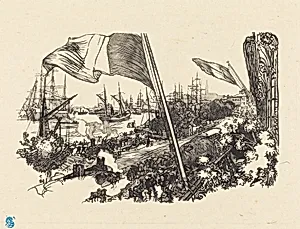
Medium
wood engraving
Classification
Department
CG-E
Museum
National Gallery of Art, Washington, D.C.
Credit
Ailsa Mellon Bruce Fund
Accession Number
1974.62.6
Rights
Public Domain
Art Historical Context
**Dedication Page** by Auguste Lepère, published in 1900, is a fine example of the wood engraving medium, a technique prized for its precision and tonal richness. Created by incising designs into the end-grain of hardwood blocks, wood engravings allowed artists like Lepère—a leading French printmaker of the late 19th and early 20th centuries—to achieve intricate details rivaling drawings. This print, classified simply as a dedication page, likely served as an ornamental frontispiece for a publication, blending artistry with book design during the vibrant fin-de-siècle era in Paris. Lepère's work reflects the enduring appeal of reproductive prints amid rising photography, showcasing his mastery in capturing light, texture, and narrative elegance. Acquired through the Ailsa Mellon Bruce Fund and housed in the National Gallery of Art's Department of Modern Prints (CG-E), it highlights the transition from illustrative traditions to modernist sensibilities. Visitors will appreciate how this modest yet sophisticated piece embodies the technical innovation and cultural prestige of French graphic arts around 1900. (178 words)
About the Artist
Auguste Lepère · 1849–1918
Auguste-Louis Lepère (1849–1918), son of the sculptor François Lepère, was born in Paris on November 30, 1849, into an artistic family that shaped his early path. At age thirteen, he apprenticed in the Paris studio of the English wood engraver Joseph Burn Smeeton, honing his skills in wood engraving until 1867. He furthered his training with drawing classes under Horace Lecoq de Boisbaudran at the...