
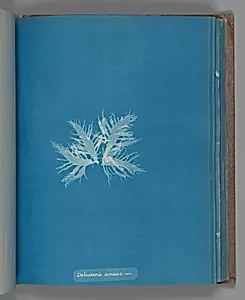
Delesseria sinvosa, var.
ca. 1853
Medium
Cyanotype
Dimensions
Image: 25.3 x 20 cm (9 15/16 x 7 7/8 in.)
Classification
Photographs
Department
Photographs
Museum
Metropolitan Museum of Art, New York, NY
Credit
Gilman Collection, Purchase, The Horace W. Goldsmith Foundation Gift, through Joyce and Robert Menschel, 2005
Accession Number
2005.100.557 (77)
Rights
Public Domain
Tags
Art Historical Context
Behold *Delesseria sinvosa, var.* (ca. 1853), a delicate cyanotype by pioneering photographer Anna Atkins, now housed in the Metropolitan Museum of's Gilman Collection. This intimate image, measuring just 25.3 x 20 cm, captures the fronds of a seaweed specimen with stunning precision, exemplifying Atkins' groundbreaking work in botanical photography during the dawn of the medium. Cyanotype, invented by Sir John Herschel in 1842, produces its signature Prussian blue tones through a chemical process involving ferric ammonium citrate and potassium ferricyanide. Atkins, a British scientist and artist, embraced this technique for its simplicity and fidelity, creating "photograms"—direct positive images formed by placing objects on light-sensitive paper and exposing them to sunlight. This work likely belongs to her seminal series documenting British algae, blending scientific illustration with artistic innovation. Atkins' contributions hold immense historical significance as some of the earliest photographic prints, predating most commercial photography and advancing women's roles in science and art. Visitors will appreciate how this ethereal blue study not only reveals nature's hidden beauty but also marks a pivotal moment when photography emerged as a tool for both documentation and aesthetic wonder.
About the Artist
Anna Atkins · 1799–1871
Anna Atkins (née Children), born on March 16, 1799, in Tonbridge, Kent, England, grew up immersed in the world of science thanks to her father, John George Children, a prominent chemist, zoologist, and curator at the British Museum. After her mother Hester's death shortly after childbirth in 1800, Anna formed a close bond with her father, receiving an exceptional scientific education rare for wome...