
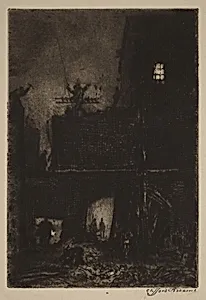
Demolition, Lincoln's Inn Fields
c. 1919
Medium
etching in black
Dimensions
plate: 11.91 × 8.1 cm (4 11/16 × 3 3/16 in.)
Classification
Department
CG-W
Museum
National Gallery of Art, Washington, D.C.
Credit
Rosenwald Collection
Accession Number
1943.3.208
Rights
Public Domain
Art Historical Context
Clifford Addams's *Demolition, Lincoln's Fields* (c. 1919) captures a poignant moment of urban transformation in one of London's most historic squares. Lincoln's Inn Fields, surrounded by elegant 17th- and 18th-century, was a hub for legal institutions and Georgian elegance. This small etching (plate: 11.91 × 8.1 cm) freezes the chaos of demolition, likely reflecting post-World War I rebuilding efforts that reshaped the city amid economic recovery and modernization. Rendered in black etching—an intaglio technique where acid etches fine lines into a metal plate for inking and printing—Addams employs sharp contrasts and delicate textures to evoke transience. His style, influenced by American printmaking traditions akin to James McNeill Whistler, excels in architectural detail, turning rubble and scaffolding into a study of light, shadow, and impermanence. The monochromatic palette heightens the drama, inviting viewers to ponder the tension between preservation and progress. Housed in the National Gallery of Art's Rosenwald Collection (Department: CG-W), this print exemplifies early 20th-century etching's precision and portability. It reminds us how artists like Addams documented fleeting urban narratives, preserving slices of history on paper for future generations.