
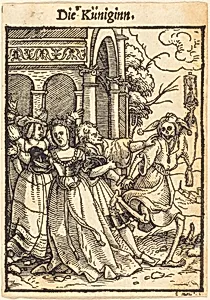
Der Kuniginn (The Queen)
Medium
woodcut
Classification
Department
CG-E
Museum
National Gallery of Art, Washington, D.C.
Credit
Rosenwald Collection
Accession Number
1948.11.130
Rights
Public Domain
Art Historical Context
"Der Kuniginn ( Queen)" is a striking woodcut from around 1526, designed by the masterful Hans Holbein the Younger and cut by Hans Lützel. Part of Holbein's renowned *Dance of Death* series, this print captures the Northern Renaissance fascination with mortality, a popular medieval motif revived during the early Reformation. In it, Death—often depicted as a skeletal figure— the elegant queen in a grim procession, underscoring that no rank, not even royalty, escapes the great equalizer. Holbein, a German-Swiss portraitist celebrated for his precise realism and psychological depth, created intricate designs that Lützelburger translated into woodcuts with extraordinary finesse. Woodcuts, as a print medium, were revolutionary for their ability to produce affordable multiples, spreading artistic and moral messages across Europe amid religious upheaval. Lützelburger's technical virtuosity shines in the fine lines and textures, rivaling engraving and preserving Holbein's dynamic compositions. Housed in the National Gallery of Art's Rosenwald Collection, this print exemplifies the collaborative genius of Renaissance printmaking. It invites visitors to reflect on themes of vanity and transience, timeless reminders from the 16th century that resonate today.