
Der Kuss (Liebespaar)
1908 (vollendet 1909)
Medium
Figuraler Bereich: Blattgold, Blattsilber, Blattplatin, Ölharzfarben, auf grundierter Leinwand. – Hintergrund: Schlagmetall (Messing), mit Lasuren übermalt, Blattmetallflocken gestreut
Dimensions
180 × 180 cm
Classification
Gemälde
Department
Belvedere Collection
Museum
Belvedere
Credit
Belvedere, Vienna
Accession Number
912
Rights
Public Domain
About this artwork
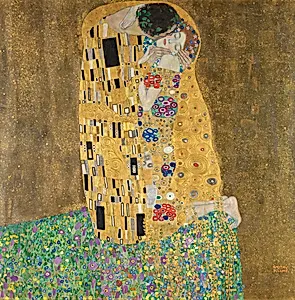
Ohne konkreten Auftrag malt Gustav Klimt auf dem Höhepunkt seiner Goldenen Periode sein wohl berühmtestes Werk: Es zeigt ein Paar, wie zu einer Einheit verschmolzen, am Rande einer Blumenwiese. Nur die unterschiedliche Musterung der Gewänder setzt die Körper voneinander ab, die von einer goldschimmernden Gloriole umfangen werden. Tatsächlich verwendet Klimt in seinem Bild echtes Blattgold, Silber und Platin. Er beginnt mit der Arbeit an dem Gemälde vermutlich 1907 und stellt es im Juni des Folge...
Art Historical Context
Gustav Klimt's *Der Kuss (Liebespaar)*, completed in 1909, stands as the crowning jewel of his Golden Phase, a pinnacle of Vienna Secession artistry. Painted without a specific commission around 1907–1908, this monumental 180 × 180 cm square canvas captures an intimate couple locked in an eternal embrace on the edge of a blooming meadow. Their bodies seem to merge into one, distinguished only by the intricate, contrasting patterns on their robes, all enveloped in a radiant golden halo that symbolizes unity and transcendence. Klimt's revolutionary technique elevates the work: the figural area gleams with real gold, silver, and platinum leaf applied over oil-resin paints on primed canvas, while the background shimmers with brass particles glazed and flecked with metal. Debuted as *Liebespaar* at the 1908 Kunstschau exhibition, it was swiftly purchased by the Austrian Ministry for the Moderne Galerie—now the Belvedere in Vienna—for a then-record sum, later retitled *Der Kuss* in a 1909 catalog. Today, this iconic painting embodies eroticism, opulence, and modernist innovation, drawing millions to marvel at its luminous allure and Klimt's fusion of symbolism with decorative splendor. A timeless ode to love, it remains one of the world's most beloved masterpieces.
About the Artist
Gustav Klimt · 1862–1918
Gustav Klimt was born on July 14, 1862, in Baumgarten near Vienna, the second of seven children in a modest family of artistic bent. His father, Ernst Klimt, a gold engraver who had immigrated from Bohemia, and his mother, Anna Finster, an aspiring musician, instilled an early appreciation for craft and creativity amid financial hardship. Klimt displayed prodigious drawing talent, prompting his en...