
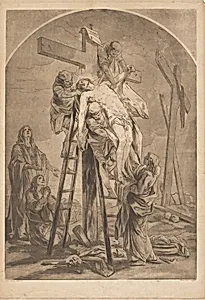
Descent from the Cross
Medium
etching and aquatint with roulette printed in black on laid paper [proof]
Dimensions
sheet: 60 × 41 cm (23 5/8 × 16 1/8 in.) plate: 57.8 × 41 cm (22 3/4 × 16 1/8 in.) image: 53.1 × 37.4 cm (20 7/8 × 14 3/4 in.)
Classification
Department
CG-E
Museum
National Gallery of Art, Washington, D.C.
Credit
Pepita Milmore Memorial Fund
Accession Number
2018.91.10
Rights
Public Domain
Art Historical Context
This etching and aquatint captures the poignant moment of Christ’s removal from the cross, a subject long revered in Christian art for its emotional depth and themes of sacrifice and redemption. Created around 1762–1763 by François-Philippe Charpentier after an original composition by Carle Van Loo, the print translates the dramatic gestures and tender expressions of the figures into a graphic medium. As a reproductive print, it made Van Loo’s design accessible to a wider audience, reflecting the 18th-century demand for devotional images that could be collected and contemplated in private settings. Charpentier’s choice of techniques is particularly noteworthy. Etching provided fine linear detail, while aquatint and roulette introduced rich tonal areas and textured shading that mimic the subtle gradations of painting. Printed in black on laid paper as a proof, this impression reveals the artist’s careful experimentation with the plate before final editions were pulled. Such technical innovation helped elevate printmaking from mere reproduction to an expressive art form in its own right. Housed in the National Gallery of Art through the Pepita Milmore Memorial Fund, the work offers today’s visitors a window into both religious devotion and the evolving craft of printmaking during the Enlightenment era. Its measured scale and refined surface invite close looking, rewarding viewers with the quiet intensity of this sacred narrative.