
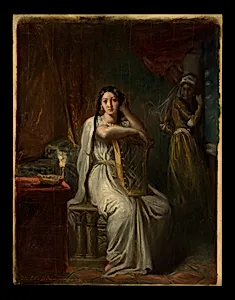
Desdemona (The Song of the Willow)
Medium
Oil on wood
Dimensions
13 3/4 x 10 5/8 in. (34.9 x 27 cm)
Classification
Paintings
Department
European Paintings
Museum
Metropolitan Museum of Art, New York, NY
Credit
Bequest of Mrs. Charles Wrightsman, 2019
Accession Number
2019.141.8
Rights
Public Domain
Tags
Art Historical Context
In Théodore Chassériau intimate *Desdemona (The of the Willow)* of 1849, we encounter a poignant moment from Shakespeare's *Othello The painting depicts the tragic heroine Desdemona, her illuminated with quiet sorrow as she strums a lyre, singing the haunting "Willow ballad on the eve of her murder. Created during the height of French Romanticism, Chassau—a prodigious talent who bridged the precise elegance of Ingres and the dramatic passion of Delacroix—captures her vulnerability with luminous skin tones and soft, expressive lighting, evoking deep emotional resonance. Painted in oil on wood, a medium favoring the jewel-like detail suited to its modest 13¾ × 10⅝-inch scale, the work exemplifies Chassériau's mastery of exoticism and sensuality in female figures. This small gem reflects mid-19th-century fascination with Shakespearean themes in European art, blending literary drama with Romantic introspection. Today, it graces the Metropolitan Museum of Art's European Paintings department, a bequest from Mrs. Charles Wrightsman in 2019, inviting visitors to ponder Desdemona's fateful grace.
About the Artist
Théodore Chassériau · 1819–1856
Théodore Chassériau was born on September 20, 1819, in El Limón, Samaná, in the Spanish colony of Santo Domingo — present-day Dominican Republic — to a French father and a Creole mother. The family relocated to Paris in 1820, and the young Chassériau's exceptional talent was evident almost immediately. At just eleven years old, in 1830, he was accepted into the prestigious studio of Jean-Auguste-D...