
Design for a Balustrade with Female Figures and Urns
16th–17th century
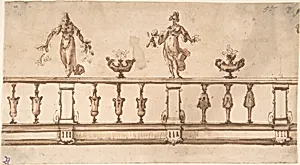
Medium
Pen and brown ink, brush and brown wash and pink watercolor, over graphite and ruled construction
Dimensions
sheet: 7 x 12 13/16 in. (17.8 x 32.5 cm)
Classification
Drawings|Ornament & Architecture
Department
Drawings and Prints
Museum
Metropolitan Museum of Art, New York, NY
Credit
The Elisha Whittelsey Collection, The Elisha Whittelsey Fund, 1952
Accession Number
52.570.107
Rights
Public Domain
Tags
Art Historical Context
Giulio Parigi's *Design for a Balustr with Female Figures and Ur* is a captivating preparatory drawing from the late 16th to early 17th century showcasing the Italian architect's flair for ornate architectural elements. Created during the transition from Mannerism to Baroque, it features elegant female figures gracefully integrated with classical urns along a balustrade—a decorative railing often used in grand palaces, gardens, and public spaces. Parigi, a prominent Florentine designer associated with the Medici court, in such ornamental schemes for festivals, theaters, and architecture, blending human forms with symbolic motifs like urns, which evoked antiquity and abundance. Rendered on a modest sheet of 7 x 12 13/16 inches, the work employs a meticulous mixed-media technique: graphite underdrawing with ruled lines for precision, overlaid with pen and brown ink for crisp outlines, brush and brown wash for subtle shading, and delicate pink watercolor for highlights on the figures. This layered approach allowed architects like Parigi to convey three-dimensionality and texture, making it an ideal blueprint for sculptors or builders. Housed in the Metropolitan Museum of Art's Drawings and Prints department, this piece highlights the Renaissance emphasis on harmonious proportion and classical revival, influencing lavish European decorative arts. Visitors will appreciate how it captures the era's celebration of beauty, symmetry, and the female form in everyday grandeur.
About the Artist
Giulio Parigi · 1571–1635
Parigi studied in Florence with his great-uncle Bartolommeo Ammannati, his father Alfonso di Santi Parigi and the Grand-Ducal architect Bernardo Buontalenti, whom he succeeded in 1608. Ca. 1598 to ca. 1629, Parigi operated an academy in Florence which taught geometry, perspective, draughtsmanship, mechanics and civil and military architecture. For the first half of the 16th century, Parigi and his...