
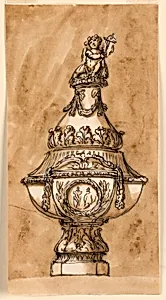
Design for a Baptismal Font
Medium
architecture
Classification
architecture
Department
Smithsonian Collection
Museum
Smithsonian American Art Museum
Credit
Museum purchase through gift of various donors and from Eleanor G. Hewitt Fund
Accession Number
1938-88-1411
Rights
Public Domain
About this artwork
Research in Progress
Art Historical Context
Giuseppe Barberi, a prominent Italian architect (1746–1809), created this *Design for a Baptismal Font* around 1775, capturing the elegance of late 18th-century Italian design. As a drawing in the architectural medium, it represents a preparatory blueprint for a sacred vessel used in Christian baptism rituals—symbolizing purification and rebirth. Barberi's work reflects the period's shift toward neoclassical restraint, blending classical motifs with functional beauty in ecclesiastical architecture. Baptismal fonts were central to church interiors, often commissioned as ornate focal points to inspire devotion. This design, now in the Smithsonian American Art Museum's collection (purchased through donor gifts and the Eleanor G. Hewitt Fund), highlights cross-cultural exchanges, bridging Italian craftsmanship with American collections. Though research is ongoing, it offers a window into how architects like Barberi envisioned harmonious spaces for worship. Visitors will appreciate its intricate lines, evoking Rome's enduring architectural legacy during the Enlightenment era. A testament to meticulous planning, it invites reflection on faith, form, and the artistry behind sacred objects.