
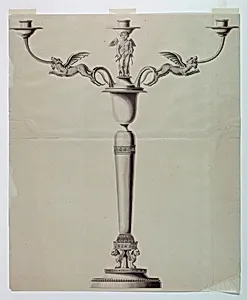
Design for a Candlestick
Classification
metalwork
Department
Smithsonian Collection
Museum
Smithsonian American Art Museum
Credit
Purchased for the Museum by the Advisory Council
Accession Number
1911-28-353
Rights
Public Domain
About this artwork
Research in Progress
Art Historical Context
**Design for a Candlestick** by Joseph Anton Seethaler II (German, 1799–1868) dates to the 1820s–1830s, a period when German craftsmanship blended neoclassical elegance with emerging industrial precision. As a design drawing for metalwork, this piece captures the meticulous planning behind functional yet ornate household objects, reflecting the era's emphasis on refined domestic luxury amid Europe's post-Napoleonic recovery. Seethaler's work exemplifies the technical expertise of German metalworkers, who were renowned for intricate silver and brass pieces that adorned bourgeois homes. Though the exact medium remains unknown amid ongoing research, such designs were typically rendered in ink, pencil, or watercolor to guide silversmiths, ensuring symmetry and decorative motifs like scrolling acanthus or floral elements translated flawlessly into durable metal. This artifact highlights the fusion of artistry and utility central to 19th-century decorative arts. Acquired by the Smithsonian American Art Museum through its Advisory Council, the piece bridges European traditions with American collections, inviting us to appreciate the unsung preparatory stages of metalwork mastery. A testament to enduring craftsmanship, it evokes the glow of candlelit evenings in a bygone age.