
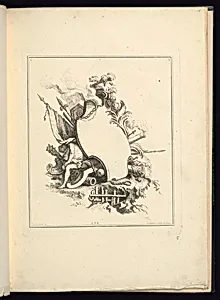
Design for a Cartouche Evoking War
Classification
ornament
Department
Smithsonian Collection
Museum
Smithsonian American Art Museum
Credit
Purchased for the Museum by the Advisory Council
Accession Number
1921-6-326-14
Rights
Public Domain
About this artwork
Research in Progress
Art Historical Context
Jacques de Lajoüe (1687–1761), a prominent French Rococo artist, created *Design for a Cartoucheoking War* in 0. As a master of decorative design, Lajoüe specialized in ornate motifs for architecture, furniture, and, blending elegance with intricate details. A cartouche is a scrolled, oval-shaped ornamental frame often used to enclose inscriptions, coats of arms, or emblems on buildings, maps, and silverwork. This piece, classified as an ornament, exemplifies Rococo era's love for elaborate, asymmetrical decoration, where playful curves and flourishes conveyed themes like triumph or martial glory. Set against the backdrop of 18th-century Europe, where France under Louis XV celebrated both courtly refinement and military prowess, Lajoüe's design likely incorporates war-inspired elements—such as trophies, weapons, or allegorical figures—to evoke power and victory. Rococo ornamentation transformed such motifs into graceful, stylized forms, softening their aggression with artistic whimsy. Though the medium remains unidentified amid ongoing research, such designs were typically rendered in pen and ink, gouache, or engraving, influencing European and colonial decorative arts. Now housed in the Smithsonian American Art Museum, purchased by the Advisory Council, this work highlights transatlantic exchanges in design. It invites visitors to appreciate how French Rococo elegance shaped global aesthetics, bridging fine art and everyday ornamentation with timeless flair.