
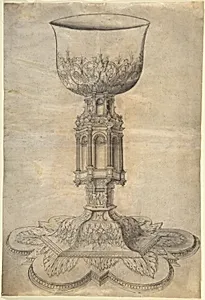
Design for a Chalice
16th century
Medium
Pen and black ink, brush and gray wash
Dimensions
Sheet: 12 11/16 × 8 11/16 in. (32.3 × 22 cm)
Classification
Drawings
Department
Drawings and Prints
Museum
Metropolitan Museum of Art, New York, NY
Credit
The Elisha Whittelsey Collection, The Elisha Whittelsey Fund, 1951
Accession Number
51.507.1
Rights
Public Domain
Tags
Art Historical Context
This delicate *Design for a Chalice created by an anonymous Netherlandish in the late 16 century, offers a glimpse into the ornate world of Renaissance ecclesiastical metalwork. During this period in the Low Countries, amid religious upheavals like the Reformation, Catholic artisans crafted intricate liturgical vessels to adorn altars and symbolize devotion. Chalices, used to hold the Eucharistic wine, were often richly decorated with symbolic motifs, reflecting both spiritual reverence and the era's mastery of decorative arts. Executed in pen and black ink with brush and gray wash on a modest sheet measuring 12 11/16 × 8 11/16 inches, the drawing exemplifies preparatory techniques favored by goldsmiths and silversmiths. The precise ink lines delineate the chalice's elegant proportions and elaborate engravings, while subtle gray washes add volume and depth, mimicking the gleam of polished silver or gold. Such designs were functional blueprints, bridging the gap between sketch and sacred object, and highlight the Netherlandish flair for intricate, Mannerist detailing. Housed in the Metropolitan Museum of Art's Drawings and Prints department as part of The Elisha Whittelsey Collection, this anonymous work underscores the collaborative craft traditions of the time, where artists served workshops producing treasures for churches across Europe. It invites us to appreciate the unseen labor behind enduring religious icons.