
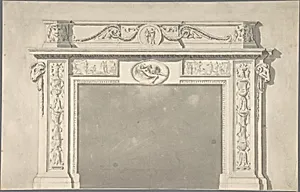
Design for a Classical Chimneypiece with Rams Heads, and Leda and the Swan.
1745–1800
Medium
Pen and ink, brush and wash
Classification
Drawings|Ornament & Architecture
Department
Drawings and Prints
Museum
Metropolitan Museum of Art, New York, NY
Credit
Harris Brisbane Dick Fund, 1935
Accession Number
35.73.32
Rights
Public Domain
Tags
Art Historical Context
**Design for a Classical Chimypiece with Rams', and Leda and the Swan** *Sir William Chambers, 1745–1800* Pen and ink, brush and Sir William Chambers, a leading figure in 18th-century British neoclassicism, created this intricate design for a chimneypiece—a grand fireplace mantel that served as a focal point in interiors. Dating to the late 1740s through the 1790s, it exemplifies the era's revival of ancient Roman and Greek motifs, blending architectural precision with mythological elegance. Chambers, influenced by his Grand Tour travels and roles as architect to George III, championed symmetry and classical ornamentation in designs for palaces and public buildings like Somerset House. The composition features rams' heads—symbols of strength and fertility from antiquity—flanking the central scene of *Leda and the Swan*, a enduring myth where Zeus, as a swan, seduces the mortal Leda. This provocative motif, popular in Renaissance art, adds a layer of sensual drama to the functional hearth, highlighting neoclassicism's fusion of utility and high culture. Such designs elevated domestic spaces into statements of refined taste among the elite. Rendered in pen and ink with brush and wash for subtle shading, the drawing showcases Chambers' mastery of draftsmanship, allowing architects to visualize textures like carved marble. Acquired through the Harris Brisbane Dick Fund in 1935, this work from The Metropolitan Museum of Art's Drawings and Prints collection offers a window into the opulent world of Georgian ornamentation. (218 words)
About the Artist
Sir William Chambers · 1723–1796
### Sir William Chambers (1723–1796) Born on 23 February 1723 in Gothenburg, Sweden, to parents of Scottish descent—his father a merchant—Sir William Chambers embarked on an extraordinary path that bridged continents and cultures. At just 16, after initial education in England, he joined the Swedish East India Company, undertaking three voyages to China in the 1740s. These journeys profoundly sha...