
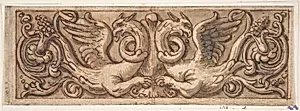
Design for a Frieze with Two Griffins
1650–1700
Medium
Pen and brown ink, brush and brown wash, over red chalk; highlighted with white gouache oxidized gray-black; framing line; verso may have been rubbed with black chalk
Dimensions
2 1/4 x 6 7/16 in. (5.7 x 16.4 cm)
Classification
Drawings|Ornament & Architecture
Department
Drawings and Prints
Museum
Metropolitan Museum of Art, New York, NY
Credit
The Elisha Whittelsey Collection, The Elisha Whittelsey Fund, 1952
Accession Number
52.570.164
Rights
Public Domain
Tags
Art Historical Context
This delicate *Design for a Frieze with Two Griffins*, created by an anonymous Italian artist around 1650–1700, offers a glimpse into the ornate world of Baroque architectural decoration. Friezes—horizontal bands of sculpted or painted ornament adorning buildings—were a hallmark of 17th-century Italian design, gracing palaces, churches, and public spaces. Here, majestic griffins, hybrid creatures with the body of a lion and the head and wings of an eagle, flank the composition, symbolizing strength, vigilance, and divine protection in classical mythology and Renaissance revival motifs. Crafted on a modest scale (just 2¼ x 6⅞ inches), the drawing employs a sophisticated mixed-media technique: red chalk underdrawing provides a fluid foundation, overlaid with precise pen and brown ink lines, enriched by brush and brown wash for depth and shadow. White gouache highlights, now oxidized to a gray-black patina, add luminous modeling, while a framing line suggests it was prepared for presentation or transfer. The possible black chalk rubbing on the verso hints at a practical use for tracing onto larger surfaces, revealing the iterative process of architectural draftsmen. Housed in the Metropolitan Museum of Art's Drawings and Prints department, this anonymous gem underscores the collaborative, behind-the-scenes artistry of Italy's Baroque era, where mythical motifs bridged antiquity and opulent modernity, inspiring grand interiors that awed contemporaries.