
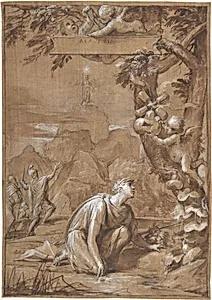
Design for a Frontispiece; Allegorical Composition with a Young Man Kneeling before a Tree
1615–66
Medium
Pen and brown ink, brush and brown wash, highlighted with white, over black chalk, on brown-washed paper
Dimensions
9-7/16 x 6-5/8 in. (24.0 x 16.9 cm)
Classification
Drawings|Ornament & Architecture
Department
Drawings and Prints
Museum
Metropolitan Museum of Art, New York, NY
Credit
The Elisha Whittelsey Collection, The Elisha Whittelsey Fund, 1952
Accession Number
1980.119
Rights
Public Domain
Tags
Art Historical Context
Giovanni Angelo Canini (1609–1666), a Roman Baroque artist known for his elegant drawings and frescoes, this preparatory design around the mid-17th century. Titled *Design for a Frontisp; Allegorical Composition with a Young Man Kneeling before a Tree*, depicts a symbolic scene likely intended for a book title page or engraved frontispiece. Such designs were popular in the Baroque era, blending architecture, ornament, and allegory to convey themes of virtue, devotion, or classical learning, with the kneeling youth perhaps symbolizing humility or reverence toward nature or wisdom. Executed on brown-washed paper, the work masterfully combines black chalk underdrawing with pen and brown ink lines, brush-applied brown wash for tonal depth, and white heightening for dramatic light effects. This mixed-media technique, common among 17th-century Italian draughtsmen, allowed Canini to simulate three-dimensionality and sculptural forms, bridging drawing and printmaking. It exemplifies the preparatory sketches used by artists like Canini—influenced by masters such as Domenichino—to refine compositions before final execution. Housed in the Metropolitan Museum of Art's Elisha Whittelsey Collection, this sheet highlights the ornamental and architectural focus of Baroque graphic arts, reflecting Rome's vibrant print culture. Visitors will appreciate its intricate detail and luminous modeling, a testament to Canini's skill in capturing allegorical grandeur on an intimate scale.