
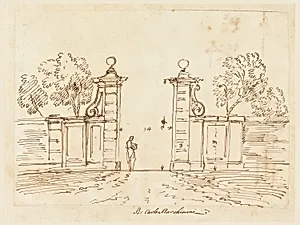
Design for a Gate of a Villa
Classification
architecture
Department
Smithsonian Collection
Museum
Smithsonian American Art Museum
Credit
Museum purchase through gift of various donors
Accession Number
1901-39-619
Rights
Public Domain
About this artwork
Research in Progress
Art Historical Context
**Design for a Gate of Villa** by Carlo Marchionni (, 1702–1786) invites visitors into the grandeur of 18th-century architecture. Created between 1750 and1755, this conceptual design captures the entrance to a villa—a quintessential feature of elite country estates during the late Baroque and emerging Rococo eras. Marchionni, a Roman architect known for his elegant integrations of sculpture and structure, likely envisioned a gate that balanced symmetry, ornamentation, and welcoming scale, serving as both a functional portal and a statement of prestige. In mid-18th-century Italy, villas symbolized refined leisure for the nobility, with gates acting as theatrical thresholds to private paradises inspired by classical antiquity. Such designs often drew from Vitruvian principles, emphasizing proportion and harmony amid lavish detailing. Though the medium remains unidentified—possibly pen and ink or watercolor on paper—this architectural drawing exemplifies how architects like Marchionni planned opulent exteriors to impress visitors upon arrival. Now housed in the Smithsonian American Art Museum through generous donor gifts, this piece bridges European tradition and American collections, underscoring the timeless appeal of Italian design. Research continues, promising deeper insights into Marchionni's process and influences. (198 words)