
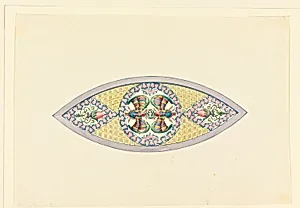
Design for a Glass Panel Window for the Coved Ceiling in the Music Room
Medium
architecture
Classification
architecture
Department
Smithsonian Collection
Museum
Smithsonian American Art Museum
Credit
Museum purchase through gift of Mrs. John Innes Kane
Accession Number
1948-40-89
Rights
Public Domain
About this artwork
Research in Progress
Art Historical Context
Frederick Crace’s “Design for a Glass Panel Window for the Coved Ceiling in the Music Room” offers a rare glimpse into the interior schemes of early nineteenth-century Britain. Created around 1817, this architectural drawing captures Crace’s vision for an elegant glass panel that would have crowned the curved ceiling of a music room, allowing light to filter softly into the space while adding decorative sophistication. As an English designer active from 1779 to 1859, Crace was celebrated for his contributions to grand domestic interiors, blending neoclassical motifs with practical elegance suited to the period’s growing taste for intimate performance spaces. The work’s significance lies in its dual role as both functional architecture and artistic blueprint. Glass panels in coved ceilings were prized for their ability to enhance acoustics and illumination, transforming music rooms into luminous settings for private concerts and social gatherings. Though currently labeled “Research in Progress,” the piece highlights how such preparatory designs guided the creation of immersive environments that married craftsmanship with sensory experience. Now part of the Smithsonian American Art Museum’s collection, this drawing was acquired through the generosity of Mrs. John Innes Kane. It invites visitors to imagine the interplay of light, sound, and ornament that once animated elite domestic life.