
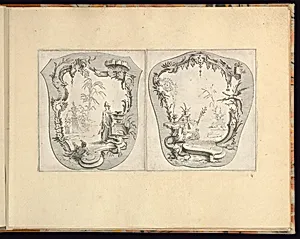
Design for a Hand Fan (Right Plate)
ca.1734–37
Medium
Classification
Department
Smithsonian Collection
Museum
Smithsonian American Art Museum
Credit
Purchased for the Museum by the Advisory Council
Accession Number
1921-6-490-5
Rights
Public Domain
About this artwork
Research in Progress
Art Historical Context
### Design for a Hand Fan (Right Plate) Created around 1734–37 by the French artist Bellay, who was active from that year onward, this print served as a design template for the right side of a hand fan. during the early Rococo period in France under Louis XV, hand fans were indispensable fashion accessories for women, elaborately decorated to convey status, flirtation, or social commentary through subtle motifs and imagery. As a print—likely an etching or engraving—this work represents a practical fusion of art and craft, allowing designs to be easily reproduced and transferred onto delicate fan surfaces like paper or silk mounted on ivory or wood sticks. The "Right Plate" designation hints at a paired composition, common in fan designs to create balanced, symmetrical scenes when folded or fanned open. Bellay's output reflects the era's booming market for decorative prints, which democratized elegant motifs for the bourgeoisie while catering to aristocratic tastes. Housed in the Smithsonian American Art Museum's collection—purchased by the Advisory Council—this piece underscores the transatlantic appeal of French ornamental arts, even in American contexts. Ongoing research promises to reveal more about Bellay's techniques and influences, inviting visitors to ponder the artistry behind everyday elegance.