
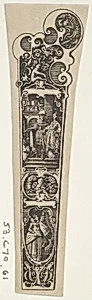
Design for a Knife Handle with Well-Dressed Couples
1580–1600
Medium
Engraving and blackwork
Dimensions
Sheet: 3 1/4 × 1 in. (8.3 × 2.5 cm)
Classification
Prints|Ornament & Architecture
Department
Drawings and Prints
Museum
Metropolitan Museum of Art, New York, NY
Credit
The Elisha Whittelsey Collection, The Elisha Whittelsey Fund, 1953
Accession Number
53.670.61
Rights
Public Domain
Tags
Art Historical Context
In the late 16th century, Theodor de Bry, a engraver from the prominent de Bry family of Antwerp, created this delicate *Design for a Knife Handle Well-Dressed Couples* 1580–1600. Measuring just 3¼ × 1 inches, this engraving and blackwork print exemplifies the ornamental designs popular during the Renaissance, when artists supplied intricate patterns for luxury objects like tableware. De Bry's precise line work captures elegant couples in fashionable attire—men and women in ruffled collars and fitted garments—flanked by birds, evoking a sense of courtly romance and nature's harmony. The medium of engraving allowed for fine details transferable to metalwork, while blackwork added depth through shaded cross-hatching, mimicking embroidered textures. Such prints bridged art and craft, enabling goldsmiths and silversmiths to adorn everyday items with sophisticated motifs. Housed in the Metropolitan Museum of Art's Drawings and Prints department, this piece from The Elisha Whittelsey Collection highlights the era's fusion of utility and beauty. Culturally, it reflects Northern European Mannerism's love for elaborate decoration amid growing trade in luxury goods. Imagine a Renaissance diner admiring these stylish figures on their knife— a subtle nod to social status and whimsy in the daily ritual of dining.
About the Artist
Johann Theodor de Bry · 1561–1923
Comment on works: copper engraver