
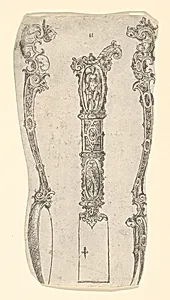
Design for a Knife, Spoon, and Fork
1560–70
Medium
Etching (unique sheet)
Dimensions
Sheet: 5 1/2 × 2 3/4 in. (14 × 7 cm) [cropped]
Classification
Prints|Ornament & Architecture
Department
Drawings and Prints
Museum
Metropolitan Museum of Art, New York, NY
Credit
Anonymous Gift, in memory of Walter E. Stait, 2013
Accession Number
2013.978.4
Rights
Public Domain
Tags
Art Historical Context
In the bustling workshops of 16th-century Antwerp, Erasmus Hornick crafted intricate designs that bridged art and everyday objects. This etching, titled *Design for a Knife, Spoon, and Fork* (ca. 1560–70), exemplifies his mastery of ornamental prints. At just 5½ × 2¾ inches on a unique, cropped sheet, it served as a blueprint for silversmiths, showcasing elegantly twisted handles adorned with grotesque motifs—fantastical creatures and scrolling foliage typical of Northern Mannerism. Etching, a relatively new technique at the time, allowed Hornick to achieve fine, fluid lines that captured the era's fascination with elaborate tableware. During the Renaissance, such prints revolutionized design dissemination, enabling artisans across Europe to replicate luxurious patterns without direct patronage. This piece reflects the growing cultural emphasis on refined dining, where cutlery became status symbols for the elite. Housed in the Metropolitan Museum of Art's Drawings and Prints department (Anonymous Gift, in memory of Walter E. Stait, 2013), it highlights how prints like this fueled the ornamental fever of the period, blending functionality with artistic whimsy. A tiny treasure revealing the artistry behind your silverware drawer!