
Design for a Memorial for Sir William Myers
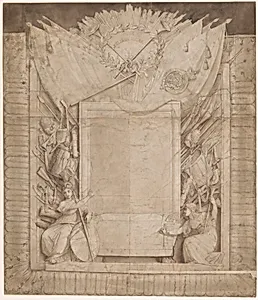
Medium
Pen and brown ink, brush and brown wash on joined sheets of paper
Dimensions
Sheet: 20 3/16 × 17 7/16 in. (51.2 × 44.3 cm)
Classification
Drawings
Department
Drawings and Prints
Museum
Metropolitan Museum of Art, New York, NY
Credit
Edward Pearce Casey Fund, 2015
Accession Number
2015.640
Rights
Public Domain
Tags
Art Historical Context
Thomas Stothard's *Design for a Memorial for William Myers* (1811) is a poignant preparatory drawing that captures the Regency-era fascination with grand commemorative architecture. Created in pen and brown ink with brush and brown wash on sheets of paper—measuring an impressive 20 316 × 17 7/16 inches—this work exemplifies Stothard's mastery as a leading English artist known for his delicate neoclassical illustrations and history paintings. The use of joined sheets allowed for a larger composition, ideal for scaling up into a monumental sculpture or monument, while the brown wash adds depth and atmospheric shading, evoking solemnity and grandeur. The design likely features symbolic elements like weapons, allegorical women, and a coat of arms, common in memorials honoring military or noble figures during the Napoleonic Wars era. Stothard, celebrated for his romantic yet refined style, infused such works with emotional narrative, blending classical motifs with personal tribute. Sir William Myers, the subject, was presumably a distinguished contemporary worthy of such remembrance, reflecting Britain's culture of public heroism. Housed in the Metropolitan Museum of Art's Drawings and Prints department (Edward Pearce Casey Fund, 2015), this piece offers visitors a window into early 19th-century draftsmanship—where ink and wash served as vital tools for envisioning lasting tributes amid turbulent times.
About the Artist
Thomas Stothard|Sir William Myers · 1755–1834
Thomas Stothard RA (1755–1834) was born on 17 August 1755 at the Black Horse Inn in London's Long Acre, the son of a prosperous publican originally from Stutton near Tadcaster. A delicate child, he was sent at age five to relatives in Yorkshire, attending schools in Acomb, Tadcaster, and later Ilford, Essex, where he honed his drawing skills by copying prints. Following his father's death in 1770,...