
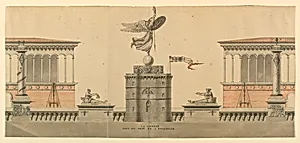
Design for a Monument Commemorating Systematization of Weights and Measures in France
Medium
architecture
Classification
architecture
Department
Smithsonian Collection
Museum
Smithsonian American Art Museum
Credit
Purchased for the Museum by the Advisory Council
Accession Number
1911-28-461
Rights
Public Domain
About this artwork
A series of monuments lined side by side. At the center, Liberty and a tricolor with the inscription "LIBERTE" are on top of a pedestal in the shape of a prison tower; laterally are statues representing weights and measurements and columns with attributes referring to science. A snake, topped by an "X" is wound around the left column under a lozenge, representing Night: the top of the column is surrounded by a railing and carries a burning-glass; a thermometer and a weather-cock, "S" and "N" are...
Art Historical Context
Jean-Jacques Lequeu, visionary French architect (1757–1826), created this intricate *Design for a Monument Comating Systematization of and Measures in France* 1795 and 1800. Rendered as an architectural proposal, it depicts a row of symbolic monuments aligned side by side on a terrace parapet. At the center rises a pedestal shaped like a tower, crowned by the figure of Liberty holding a tricolor flag inscribed "LIBERTE." Flanking it are statues representing weights and measures, plus ornate columns evoking science: the left one entwined by a snake topped with an "X" under a lozenge symbolizing Night, topped by a burning-glass within a railing; the right featuring a thermometer and weather-vane marked "S" and "N." In the background, cranes and Romanesque loggias suggest ongoing construction. This design celebrates the French Revolution's revolutionary standardization of the metric system in the 1790s, a triumph of Enlightenment rationalism over feudal inconsistencies. By placing Liberty atop a prison-like base, Lequeu evokes liberation from tyranny, while scientific instruments underscore progress and precision. His neoclassical style, infused with fantastical details, reflects the era's utopian ambitions for public monuments. Housed in the Smithsonian American Art Museum, this work highlights Lequeu's eccentric genius, blending revolutionary zeal with architectural whimsy—perfect for envisioning a new, measured world.