
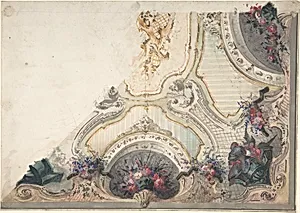
Design for a Painted Ceiling
1800–1900
Medium
Watercolor
Dimensions
8-3/4 x 12-1/4 in
Classification
Drawings
Department
Drawings and Prints
Museum
Metropolitan Museum of Art, New York, NY
Credit
Gift of the Royal Institute of British Architects, 1961
Accession Number
61.669.26
Rights
Public Domain
Tags
About this artwork
This drawings titled "Design for a Painted Ceiling" by Anonymous, Italian, 19th century dates to 1800–1900. Executed in watercolor, this work exemplifies the craftsmanship associated with Drawings and Prints. The piece demonstrates the technical skill and artistic vision characteristic of its period. The work's presence in a major museum collection attests to its significance in the broader narrative of art history. As part of institutional holdings, it serves both scholarly research and public ...
Art Historical Context
This delicate watercolor, *Design for a Painted Ceiling created by an anonymous Italian artist in 19th century ( 1800–1900), offers a glimpse into the ornate world of interior decoration during Italy's Romantic era. Measuring just 8-3/4 x 12-1/4 inches, it served as a preparatory sketch for a grand ceiling painting, likely envisioning lush floral motifs cascading across architectural vaults. Such designs were prized in palaces, villas, and public spaces, blending artistry with engineering to transform everyday ceilings into breathtaking canopies of nature. Executed in watercolor—a medium favored for its luminous transparency and precision—this drawing showcases the technical finesse of 19th-century Italian draftsmen. The floral elements, hinted at in its tags, reflect a enduring tradition of botanical ornamentation, evoking abundance and elegance amid the period's neoclassical and revivalist tastes. Watercolor's fluidity allowed artists to layer subtle colors and details, making it ideal for architectural proposals shared among patrons and builders. Now housed in the Metropolitan Museum of Art's Department of Drawings and Prints, this piece arrived as a gift from the Royal Institute of British Architects in 1961. It stands as a testament to cross-cultural exchange in design history, inviting visitors to ponder how such humble sketches birthed opulent interiors that defined 19th-century luxury and aesthetics.