
Design for a Palace Façade
early 18th–mid 18th century
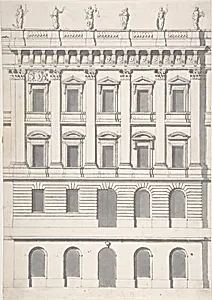
Medium
Pen and gray and black ink, brush and gray ink, chalk or graphite
Dimensions
13 11/16 x 9 5/8 in. (34.7 x 24.4 cm)
Classification
Drawings
Department
Drawings and Prints
Museum
Metropolitan Museum of Art, New York, NY
Credit
The Elisha Whittelsey Collection, The Elisha Whittelsey Fund, 1960
Accession Number
60.632.67
Rights
Public Domain
Tags
Art Historical Context
Carl Hårleman's *Design for a Palace Faade* offers a captivating glimpse into 18th-century European architectural ambition. Created between the early and mid-1700s, this drawing by the Swedish architect—renowned for his elegant Rococo designs—likely as a preparatory study for a grand palace exterior. Hårleman, who rose to prominence as Sweden's leading architect under royal patronage, blended French-inspired grandeur with Scandinavian restraint, reflecting the era's shift from opulent Baroque to lighter, more playful Rococo forms. Palaces symbolized power and enlightenment during this Age of Absolutism, and such designs visualized symmetry, pediments, and ornate detailing to impress visitors. Rendered in pen and gray and black ink, with brush and gray wash plus chalk or graphite, the work showcases meticulous drafting techniques. Fine ink lines delineate precise architectural elements like columns and cornices, while subtle washes add depth and shadow, evoking the facade's three-dimensionality on a modest 13 11/16 x 9 5/8-inch sheet. This mixed-media approach was standard for architects, allowing quick iterations before costly construction. Housed in the Metropolitan Museum of Art's Drawings and Prints department, this piece from The Elisha Whittelsey Collection highlights the artistry behind monumental buildings. It invites us to appreciate the thoughtful planning that shaped Europe's royal landscapes, bridging paper sketches to stone realities.
About the Artist
Carl Hårleman · 1700–1753
Baron Carl Hårleman (1700–1753) was a pivotal figure in Swedish architecture, born in Stockholm on August 27, 1700, to Johan Hårleman, a renowned garden architect and head of the royal parks ennobled in 1698, and Eva Johanna Baartz. Fatherless at a young age, he followed in his father's footsteps, beginning his training under architects Göran Josua Adelcrantz and Nicodemus Tessin the Younger. In 1...