
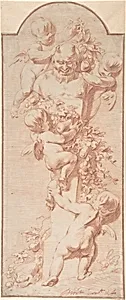
Design for a Panel with Four Putti Decorating a Herm (Terminal Figure) with Garlands of Fruit and Foliage
ca. 1720–40
Medium
Red chalk. Inlaid into heavy paper mount with brown and gold framing lines
Dimensions
16 1/8 x 6 3/4 in. (40.9 x 17.2 cm) (silhouetted into arch at top)
Classification
Drawings|Ornament & Architecture
Department
Drawings and Prints
Museum
Metropolitan Museum of Art, New York, NY
Credit
Purchase, Harris Brisbane Dick Fund and Joseph Pulitzer Bequest, 1971
Accession Number
1971.513.36
Rights
Public Domain
Tags
Art Historical Context
In the opulent world of 18th-century interiors, Jacob de Wit's *Design for a Panel with Putti Decorating a (Terminal Figure) withlands of Fruit and Fage* (ca. 1720–40) the playful exuberance of Late Baroque ornamentation transitioning into Rococo elegance. De Wit, a master of decorative schemes for Amsterdam's grand townhouses, sketched this lively composition featuring frolicsome putti—cherubic figures symbolizing abundance and joy—draping a classical herm (a sculpted bust atop a pillar) with cascading garlands of fruit and foliage. Such designs adorned overdoors, wall panels, or boiserie, evoking the grandeur of ancient Rome while suiting the era's taste for lavish domestic splendor. Rendered in vibrant red chalk and inlaid into a heavy paper mount with brown and gold framing lines, the sheet measures 16⅛ × 6¾ inches and is artfully silhouetted into an arched top, mimicking the architectural niche it was meant to occupy. Red chalk, prized for its warm tones and subtle modeling, allowed de Wit to convey texture and movement with fluid precision, a technique honed in his prolific output of preparatory drawings. This piece exemplifies his Rubenesque influence, blending mythological whimsy with intricate naturalism. Today, housed in the Metropolitan Museum of Art's Drawings and Prints department (purchased via the Harris Brisbane Dick Fund and Joseph Pulitzer Bequest, 1971), it offers a window into how ornamental drawings bridged art and architecture, delighting collectors with their intricate beauty and timeless festivity.
About the Artist
Jacob de Wit · 1695–1754
Comment on works: Religious; Allegory; Bas-relief