
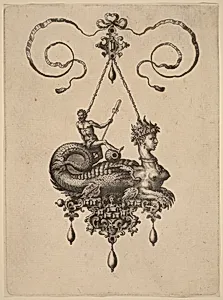
Design for a Pendant with a Sphinx with the Body of a Fish Carrying a Man with an Oar
Medium
engraving
Classification
Department
CG-E
Museum
National Gallery of Art, Washington, D.C.
Credit
Rosenwald Collection
Accession Number
1943.3.2812
Rights
Public Domain
Art Historical Context
Behold the intricate *Design for a Pendant with Sphinx with the Body of Fish Carrying a Man with Oar* (1582), an engraving by Flemish artist Hans Collaert the. Created during the late Renaissance in Antwerp, this print exemplifies the era's fascination with fantastical creatures and ornamental designs. Collaert, a master engraver from a renowned family of artists, specialized detailed prints that served as models for jewelers and goldsmiths, bridging fine art with decorative crafts. The composition bursts with imaginative symbolism: a hybrid sphinx—part mythical guardian, part aquatic marvel—bears a rower across imagined waters, evoking themes of adventure, mythology, and the sea's mysteries. Engraving, with its precise lines etched into copper plates, allowed for crisp reproduction and widespread dissemination of such designs, making high-style motifs accessible to Europe's elite. This technique highlights Collaert's skill in capturing texture and movement in miniature scale, perfect for a pendant's intimate wear. Housed in the National Gallery of Art's Rosenwald Collection (Department CG-E), this work reflects the Renaissance revival of classical grotesques blended with Northern European ingenuity. It's a window into 16th-century creativity, where art fueled fashion and folklore alike—imagine it adorning a noble's neck, whispering tales of enigma and exploration.