
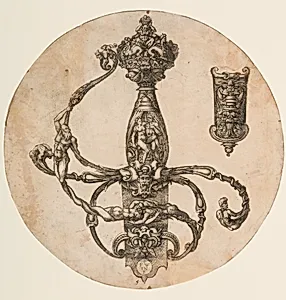
Design for a Rapier Hilt and Scabbard Chape
Medium
Etching, engraving
Dimensions
Diam. 7 1/2 in. (19.1 cm)
Classification
Works on Paper-Engravings
Culture
French
Department
Arms and Armor
Museum
Metropolitan Museum of Art, New York, NY
Credit
Purchase, Andrew Solomon Gift, 2016
Accession Number
2016.245
Rights
Public Domain
Tags
Art Historical Context
In the opulent world of Renaissance France, Pierre Woeiriot de Bouzey II crafted this intricate *Design for a Rapierilt and Scabbardape* in 1555. As a versatile artist-engraver and goldsmith from Lorraine, Woeiriot in ornamental patterns for luxury metalwork, bridging fine art and functional objects. This etching and engraving measuring 7 1/2 inches in diameter, elaborate designs for the rapier's hilt—the sword's grip—and the chape, the reinforced metal tip of its scabbard. Rapiers were emblematic of 16th-century European nobility, symbols of status wielded in duels and courts. The printmaking techniques here—etching with acid for fluid lines and engraving for precise detailing—were revolutionary for their time, allowing artists to reproduce complex motifs efficiently. These designs likely drew from the Fontainebleau school's grotesque and strapwork ornamentation, popular at the French royal court, influencing armorers and goldsmiths across workshops. Such patterns elevated arms from mere weapons to masterpieces of craftsmanship. Housed in the Metropolitan Museum of Art's Arms and Armor Department, this work highlights the era's fusion of artistry and martial culture, where even sword fittings became canvases for Renaissance ingenuity. Visitors will appreciate how Woeiriot's vision turned steel into splendor.