
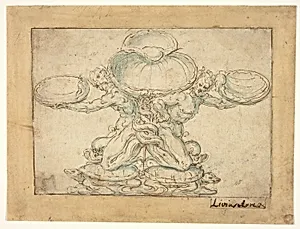
Design for a Salt Cellar or a Table Fountain
1570-1620
Medium
Pen and brown ink, with brush and blue wash, over traces of black chalk, on cream laid paper, perimeter mounted to buff wove paper, prepared with a brown wash
Dimensions
Primary support: 13.6 × 18 cm (5 3/8 × 7 1/8 in.); Secondary support: 16.3 × 22 cm (6 7/16 × 8 11/16 in.)
Classification
pen and ink drawings
Department
Prints and Drawings
Museum
Art Institute of Chicago
Accession Number
223803
Rights
Public Domain
Art Historical Context
Livio Agresti's *Design for a Salt Cell or a Table Fountain*ca. 1570–1620) captures the opulent world of Renaissance banqueting in a delicate preparatory sketch. The Italian Mannerist painter, active in Rome and known for his elegant frescoes and altarpieces, here demonstrates his versatility by designing luxurious tableware. Salt cellars and fountains were status symbols among the elite, often crafted from silver or gold, transforming everyday meals into theatrical displays of wealth and refinement. Executed on cream laid paper—a hallmark of 16th-century drafting—this intimate drawing (13.6 × 18 cm) employs pen and brown ink for precise lines, enhanced by brush and blue wash over faint black chalk underdrawing. These techniques allowed artists like Agresti to explore complex forms, shading, and spatial illusions with fluid grace, typical of Mannerist draftsmanship. The blue wash adds a subtle, atmospheric depth, evoking the gleam of polished metal. Housed in the Art Institute of Chicago's Prints and Drawings collection, this work offers a window into the collaborative world of Renaissance workshops, where painters bridged fine art and decorative objects. It highlights how such designs fueled the era's fascination with intricate, fantastical motifs, blending utility with artistic virtuosity.