
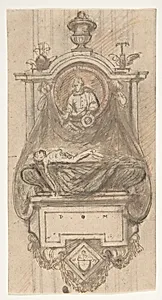
Design for a sepulchral monument with a portrait bust
Medium
Pen and brown ink, red and brown wash, red chalk, over black chalk or graphite
Dimensions
sheet: 8 1/8 x 4 1/4 in. (20.6 x 10.8 cm)
Classification
Drawings
Department
Drawings and Prints
Museum
Metropolitan Museum of Art, New York, NY
Credit
Purchase, Charles and Jessie Price Gift, 2010
Accession Number
2010.103
Rights
Public Domain
Tags
Art Historical Context
This delicate 1673 drawing presents a design for a sepulchral monument, likely intended as a tomb or church memorial featuring a prominent portrait bust of a man. Created in the Flemish Baroque tradition, such preparatory studies guided sculptors in realizing elaborate funerary works that honored the deceased while expressing themes of mortality and remembrance. The sheet’s compact size suggests it served as a working sketch, capturing the monument’s architectural framework and central sculptural element in a single, unified composition. Executed in pen and brown ink with red and brown washes over chalk, the drawing demonstrates the artist’s mastery of layered media to convey texture, depth, and light. Subtle red chalk accents model the bust’s face and drapery, while washes define the surrounding architectural details, giving the design a sculptural presence on paper. Attributed variously to Hendrik-Frans Verbruggen, Michiel van der Voort, or an anonymous Flemish draftsman, the work reflects the collaborative nature of 17th-century artistic production in the Low Countries. Preserved at the Metropolitan Museum of Art, this drawing offers visitors a rare glimpse into the creative process behind public monuments that once adorned churches and chapels across Flanders.