
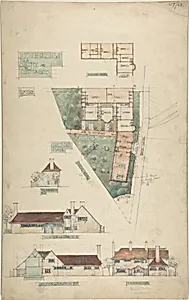
Design for a Smithy and Two Cottages
late 19th–early 20th century
Medium
Pen and ink, over graphite, with watercolor
Dimensions
sheet: 18 1/4 x 11 1/2 in. (46.4 x 29.2 cm)
Classification
Drawings|Ornament & Architecture
Department
Drawings and Prints
Museum
Metropolitan Museum of Art, New York, NY
Credit
Exchange, Royal Institute of British Architects, 1960
Accession Number
60.724.107
Rights
Public Domain
Tags
Art Historical Context
Charles Edward Mallows, a British architect of the Arts and Crafts movement created this evocative *Design for a Smithy Two Cottages* in late 19th to early 20th century The drawing depicts a harmonious rural ensemble: a sturdy blacksmith's workshop flanked by two quaint cottages, blending functionality with picturesque charm. Rendered on a modest sheet of 18¼ × 11½ inches, it captures Mallows' signature interest in vernacular architecture, drawing inspiration from England's traditional countryside buildings to promote simple, handcrafted designs amid rapid industrialization. Executed in pen and ink over graphite underdrawing, with subtle watercolor washes, the work exemplifies the precision and artistry of architectural drafting. Graphite allowed for initial sketches, ink provided crisp lines for structure and detail, and watercolor added atmospheric depth—techniques that brought Mallows' visions to life for clients and fellow architects. This mixed media approach was ideal for the era's progressive firms, emphasizing both technical accuracy and aesthetic appeal. Housed in the Metropolitan Museum of Art's Drawings and Prints department, acquired via exchange from the Royal Institute of British Architects in 1960, the design reflects the Arts and Crafts ethos of reviving medieval craftsmanship. It invites visitors to appreciate how Mallows envisioned sustainable, community-focused spaces, bridging utility and beauty in an age of modern transformation.