
Design for a Sofa with Wing-like Arms
early 19th century
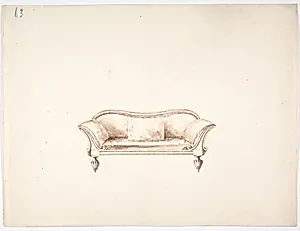
Medium
Pen and ink, brush and wash
Dimensions
sheet: 9 x 11 7/8 in. (22.8 x 30.2 cm)
Classification
Drawings|Ornament & Architecture
Department
Drawings and Prints
Museum
Metropolitan Museum of Art, New York, NY
Credit
Harris Brisbane Dick Fund, 1938
Accession Number
38.37.99
Rights
Public Domain
Tags
Art Historical Context
This delicate pen and ink with brush and wash, created by an anonymous British artist in the 19th century, a refined design for a sofa featuring distinctive wing-like arms. Measuring just 9 x 11 7/8 inches, this compact sheet captures the elegance of Regency-era furniture, a period (circa 1811–1820) when British interiors blended neoclassical symmetry with growing comfort and luxury. Wing-backed sofas like this were prized in drawing rooms, their curved arms evoking protective shelter—originally designed to trap warmth from open fireplaces while shielding sitters from drafts. The medium exemplifies precision drafting techniques of the time: fine pen lines delineate the sofa's sinuous contours and upholstery details, while subtle brush washes add tonal depth, suggesting wood grain, fabric folds, and shadow play. Classified under Drawings, Ornament & Architecture at The Metropolitan Museum of Art (acquired via the Harris Brisbane Dick Fund in 1938), it highlights the collaborative world of furniture workshops, where anonymous designers sketched prototypes for craftsmen. Such designs offer a window into 19th-century domestic life, where furniture was both functional art and a status symbol, influencing mass-produced pieces that furnished homes across Britain and beyond. A charming glimpse of creativity behind the velvet cushions!
About the Artist
Anonymous, British, 19th century · 1800–1900
**Anonymous, British, 19th century** is not the name of a single individual but a standard museum attribution used for works whose creators remain unidentified yet are clearly British and date to the 1800s. Major institutions, including the Metropolitan Museum of Art, employ this designation for hundreds of drawings, prints, designs, and decorative studies that lack signatures or firm documentary ...