
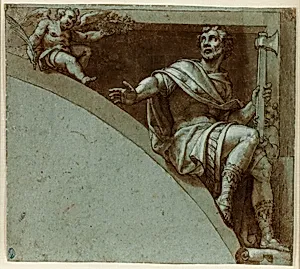
Design for a Spandrel: A Roman Martyr and Two Putti–Saint Jude the Apostle
1573/75
Medium
Pen and brown ink, with brush and brown wash, heightened with lead white gouache, on blue laid paper
Dimensions
Sight: 23.8 × 27 cm (9 3/8 × 10 11/16 in.)
Classification
pen and ink drawings
Department
Prints and Drawings
Museum
Art Institute of Chicago
Accession Number
223801
Rights
Public Domain
About this artwork
Louise Bross identified the figure as Saint Jude the Apostle and the sheet as possibly an early idea for the placement of soldier-martyrs in the spandrels of the Chapel of the Trinity at Santo Spirito in Sassia. The dramatic contrasts of the brown ink, blue paper, and white highlights further animate the figure’s illusionistic pose.
Art Historical Context
This preparatory drawing by Livio Agresti captures a dynamic design for a spandrel—the curved triangular space often found in architectural vaults. Created between 1573 and 1575, it depicts Saint Jude the Apostle as a Roman martyr accompanied by two lively putti, blending sacred narrative with graceful movement typical of late Renaissance religious art. As a study for a larger fresco or ceiling decoration, the work reveals how artists planned compositions to fit challenging architectural spaces in churches or palaces. Agresti employed pen and brown ink with fluid brown washes and delicate white gouache highlights on blue paper, a technique that allowed for rich tonal contrasts and luminous effects. This medium was favored for its ability to suggest depth and volume, helping patrons visualize the final painted result. The compact dimensions of roughly 24 by 27 centimeters make it an intimate window into the creative process behind grand decorative schemes. Housed in the Art Institute of Chicago’s Prints and Drawings department, the sheet offers visitors a rare glimpse of 16th-century draftsmanship. It underscores the collaborative nature of Renaissance projects, where such detailed studies guided teams of painters in bringing complex religious stories to life on walls and ceilings.