
Design for a Stage Set
1830–90
Classification
Drawings
Department
Drawings and Prints
Museum
Metropolitan Museum of Art, New York, NY
Credit
Gift of Mrs. Henry T. Curtis, 1953
Accession Number
53.668.249
Rights
Public Domain
Tags
Art Historical Context
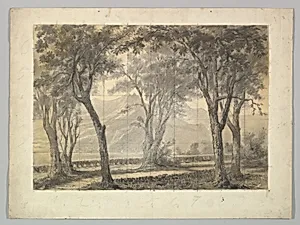
**Design for a Stage Set** by Eugène Cicéri1813–1890) the theatrical imagination of 19th-century France. Cicéri, a master scenic designer for Paris's grand opera houses like the Opéra and Opéra-Comique, specialized in creating immersive worlds for Romantic ballets and operas. This, from his active career spanning 183090, likely served as a preparatory blueprint for a stage backdrop featuring lush trees, evoking enchanted forests or pastoral scenes popular in works by composers like Meyerbeer or Auber. In an era when theater was evolving into spectacular entertainment, Cicéri's designs revolutionized stagecraft. Working amid the Romantic movement's emphasis on emotion and nature, he blended architectural precision with painterly effects to transform bare stages into vivid illusions. His gouache or watercolor techniques on paper—typical of the Drawings and Prints genre—allowed for quick iterations, vibrant colors, and atmospheric depth, influencing generations of set designers. Housed in the Metropolitan Museum of Art thanks to a 1953 gift, this piece offers a glimpse into the behind-the-scenes artistry that brought 19th-century fantasies to life. Imagine the applause as Cicéri's trees rustled under gaslit spotlights— a testament to design's power to enchant!
About the Artist
Eugène Cicéri · 1813–1890
Étienne Eugène Cicéri (1813-1890) was a French painter, lithographer, and theatrical designer who became a notable figure in the Barbizon School movement. Born in Paris on January 27, 1813, into an illustrious artistic family, he was the son of renowned scenographer Pierre-Luc-Charles Cicéri and the nephew of painter Eugène Isabey. Cicéri occupies an important position in 19th-century French land...