
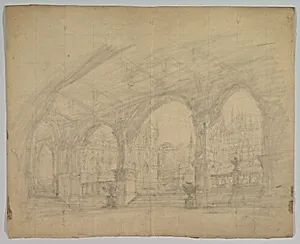
Design for a Stage Set
1830–90
Classification
Drawings
Department
Drawings and Prints
Museum
Metropolitan Museum of Art, New York, NY
Credit
Gift of Mrs. Henry T. Curtis, 1953
Accession Number
53.668.248
Rights
Public Domain
Tags
Art Historical Context
Eugène Cicéri (1813–1890), a leading French painter and scenic designer of the Romantic era, created this *Design for a Stage Set* sometime between 1830 and 1890. Active during a golden age of Parisian theater, Cicéri specialized in elaborate backdrops for grand operas, ballets, and spectacles at venues like the Opéra and Théâtre-Italien. His designs brought Romantic fantasies to life, evoking exotic landscapes, majestic palaces, and dramatic atmospheres that captivated 19th-century audiences. As a preparatory drawing from the Metropolitan Museum of Art's Drawings and Prints collection—generously gifted by Mrs. Henry T. Curtis in 1953—this work exemplifies Cicéri's mastery of gouache, watercolor, and ink on paper, techniques ideal for conveying the illusion of depth, light, and scale on stage. These sketches were blueprints for massive canvases painted by teams of artisans, transforming flat stages into immersive worlds through clever perspective and atmospheric effects. Cicéri's innovations elevated stage design as an art form, influencing the visual language of theater during France's cultural renaissance. Today, this piece offers a glimpse into the collaborative magic behind iconic performances, reminding us how drawings like this fueled the imagination of Romantic-era playgoers.
About the Artist
Eugène Cicéri · 1813–1890
Étienne Eugène Cicéri (1813-1890) was a French painter, lithographer, and theatrical designer who became a notable figure in the Barbizon School movement. Born in Paris on January 27, 1813, into an illustrious artistic family, he was the son of renowned scenographer Pierre-Luc-Charles Cicéri and the nephew of painter Eugène Isabey. Cicéri occupies an important position in 19th-century French land...