
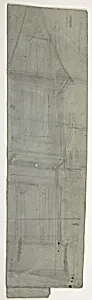
Design for a Stage Set at the Opéra, Paris
1830–90
Medium
Graphite on blue paper
Dimensions
sheet: 10 1/4 x 2 11/16 in. (26 x 6.9 cm)
Classification
Drawings
Department
Drawings and Prints
Museum
Metropolitan Museum of Art, New York, NY
Credit
Gift of Mrs. Henry T. Curtis, 1953
Accession Number
53.668.158
Rights
Public Domain
Tags
Art Historical Context
Eugène Cicéri's *Design for a Stage Set the Opéra, Paris (ca. 1830–90) offers a glimpse into the theatrical magic of 19th-century. As a leading scenic designer for the Paris Opéra, Cicéri in creating immersive backdrops that brought operas and ballets to life, blending architecture and illusion. This preparatory drawing, housed in the Metropolitan Museum of Art's Drawings and Prints, captures the essence of grand stage architecture—likely evoking palatial halls or fantastical structures through precise lines and spatial depth. Rendered in graphite on blue paper, the modest sheet (10 1/4 x 2 11/16 in.) highlights the artist's economical technique: the tinted paper provides atmospheric shading, allowing quick yet evocative sketches ideal for directors and builders. During the Romantic era, such designs were pivotal, transforming static theaters into dynamic worlds that mirrored the era's fascination with spectacle and emotion, influencing productions at one of Europe's premier venues. This gifted work from 1953 reminds us how backstage creativity fueled cultural icons, inviting visitors to imagine the Opéra's stage alive with Cicéri's vision.
About the Artist
Eugène Cicéri · 1813–1890
Étienne Eugène Cicéri (1813-1890) was a French painter, lithographer, and theatrical designer who became a notable figure in the Barbizon School movement. Born in Paris on January 27, 1813, into an illustrious artistic family, he was the son of renowned scenographer Pierre-Luc-Charles Cicéri and the nephew of painter Eugène Isabey. Cicéri occupies an important position in 19th-century French land...