
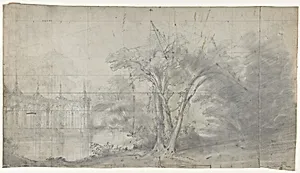
Design for a Stage Set at the Opéra, Paris
1840–90
Medium
Graphite
Dimensions
sheet: 10 11/16 x 19 3/16 in. (27.1 x 48.8 cm)
Classification
Drawings
Department
Drawings and Prints
Museum
Metropolitan Museum of Art, New York, NY
Credit
Gift of Mrs. Henry T. Curtis, 1953
Accession Number
53.668.208
Rights
Public Domain
Tags
Art Historical Context
Eugène Cicéri’s graphite drawing offers a rare glimpse into the creative process behind 19th-century Parisian theater. Created sometime between 1840 and 1890 as a design for the Opéra, sheet captures the planning of a wooded stage set, with delicate lines suggesting trees and natural scenery that would have been realized on a grand scale. Such preparatory sketches were essential tools for scenographers, allowing artists to experiment with perspective, lighting effects, and spatial depth before sets were constructed from wood, canvas, and paint. During this period, the Paris Opéra was at the height of its influence, staging lavish Romantic operas that demanded immersive environments. Cicéri, working in the tradition of French theatrical design, used graphite’s fine tonal range to convey atmosphere and movement, helping directors and technicians visualize how forests or gardens might frame dramatic action. The drawing’s modest size belies its importance as a working document that bridged an artist’s imagination and the spectacular illusions experienced by audiences. Today, this sheet in the Metropolitan Museum’s collection preserves the quiet, behind-the-scenes artistry that made 19th-century opera so visually captivating. It reminds viewers that every grand stage picture began with careful lines on paper.
About the Artist
Eugène Cicéri · 1813–1890
Étienne Eugène Cicéri (1813-1890) was a French painter, lithographer, and theatrical designer who became a notable figure in the Barbizon School movement. Born in Paris on January 27, 1813, into an illustrious artistic family, he was the son of renowned scenographer Pierre-Luc-Charles Cicéri and the nephew of painter Eugène Isabey. Cicéri occupies an important position in 19th-century French land...