
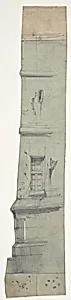
Design for a Stage Set at the Opéra, Paris
1840–90
Medium
Graphite
Dimensions
sheet: 11 9/16 x 2 7/16 in. (29.3 x 6.2 cm)
Classification
Drawings
Department
Drawings and Prints
Museum
Metropolitan Museum of Art, New York, NY
Credit
Gift of Mrs. Henry T. Curtis, 1953
Accession Number
53.668.215
Rights
Public Domain
Tags
Art Historical Context
Eugène Cicéri’s graphite drawing captures a preparatory vision for a stage set at the Paris Opéra, created sometime between 1840 and 1890. During this period, the Op stood at the heart of cultural life, where Romantic-era productions demanded increasingly scenery to transport audiences. Cicéri, part of a distinguished family of theater designers, helped shape these immersive environments through precise architectural renderings that guided carpenters and painters. Executed in graphite on a slender sheet measuring roughly 11½ by 2½ inches, the work demonstrates the economy and clarity required of stage-design sketches. The narrow format likely corresponds to a side wing or vertical element within a larger set, allowing designers to sightlines and proportions before full-scale construction. Such drawings reveal the collaborative artistry behind live performance, blending fine draftsmanship with practical theatrical needs. Now part of the Metropolitan Museum’s collection of Drawings and Prints, this study offers visitors a quiet window into the behind-the-scenes creativity that made 19th-century opera spectacles unforgettable.
About the Artist
Eugène Cicéri · 1813–1890
Étienne Eugène Cicéri (1813-1890) was a French painter, lithographer, and theatrical designer who became a notable figure in the Barbizon School movement. Born in Paris on January 27, 1813, into an illustrious artistic family, he was the son of renowned scenographer Pierre-Luc-Charles Cicéri and the nephew of painter Eugène Isabey. Cicéri occupies an important position in 19th-century French land...