
Design for a Stage Set at the Opéra, Paris: Church Interior
1830–90
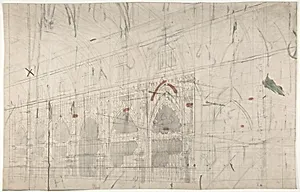
Medium
Pen and gray ink, brush and gray wash, gouache, over graphite
Dimensions
sheet: 10 7/8 x 17 1/16 in. (27.7 x 43.4 cm)
Classification
Drawings
Department
Drawings and Prints
Museum
Metropolitan Museum of Art, New York, NY
Credit
Gift of Mrs. Henry T. Curtis, 1953
Accession Number
53.668.241
Rights
Public Domain
Tags
Art Historical Context
Eugène Cicéri'sDesign for a Stage Set the Opéra, Paris Church Interior* (ca. 1830–90) captures the grandeur of 19th-century spectacle. As a leading scenic designer for the Paris Opéra, Cicéri specialized in creating immersive environments for grand operas and ballets, elaborate sets transported audiences to dramatic worlds. This drawing depicts a vast church interior, evoking the architectural splendor of Gothic or neoclassical cathedrals, tailored to the Opéra's stage to heighten emotional impact during performances. Rendered in pen and gray ink, brush and gray wash, gouache over graphite on a sheet measuring 10 7/8 x 17 1/16 inches, the work showcases Cicéri's mastery of mixed media. Graphite underdrawing provides precise architecture, while fluid washes and gouache build atmospheric depth, simulating light filtering through stained-glass windows and stone vaults. These techniques were essential for stage designers, allowing quick visualization of how painted backdrops and props would appear under gaslight. Housed in the Metropolitan Museum of Art's Drawings and Prints department (gift of Mrs. Henry T. Curtis, 1953), this piece highlights the fusion of art and theater in Romantic-era France, where scenery rivaled the stars. It offers a glimpse into the Opéra's golden age, blending architectural realism with illusory magic.
About the Artist
Eugène Cicéri · 1813–1890
Étienne Eugène Cicéri (1813-1890) was a French painter, lithographer, and theatrical designer who became a notable figure in the Barbizon School movement. Born in Paris on January 27, 1813, into an illustrious artistic family, he was the son of renowned scenographer Pierre-Luc-Charles Cicéri and the nephew of painter Eugène Isabey. Cicéri occupies an important position in 19th-century French land...