
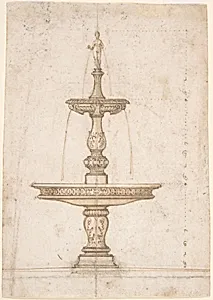
Design for a Table Fountain
Medium
Pen and brown ink and brown wash over black chalk
Dimensions
6 7/8 x 4 13/16 in. (17.5 x 12.3 cm)
Classification
Drawings|Ornament & Architecture
Department
Drawings and Prints
Museum
Metropolitan Museum of Art, New York, NY
Credit
Clifford A. Furst Bequest, by exchange and The Elisha Whittelsey Collection, The Elisha Whittesey Fund, 1997
Accession Number
1997.56
Rights
Public Domain
Tags
Art Historical Context
This exquisite "Design for a Table Fountain" a 16th-century drawing from Germany, attributed to Hans Hol the Younger or an anonymous of the era. Holbein, a master of the Northern Renaissance known for his precise portraits and intricate designs, exemplifies the period's blend of artistry and craftsmanship. Created during a time when Renaissance humanism spurred innovation in decorative arts, such sketches guided goldsmiths and sculptors in crafting luxury items for elite patrons. Rendered in pen and brown ink with brown over black chalk on a modest 6 7/8 x 4 13/16-inch sheet, the drawing showcases meticulous line work and subtle shading to convey three-dimensional form. This mixed-media technique was ideal for architectural ornament, allowing artists to explore complex motifs like flowing water features and fantastical elements with remarkable clarity and depth. Table fountains were coveted tabletop marvels—miniature hydraulic spectacles that entertained with spouting water or wine amid ornate sculptures. Housed in the Metropolitan Museum of Art's Drawings and Prints department, this piece illuminates the German Renaissance's obsession with ingenuity and wonder, bridging fine art and functional design in an age of discovery.