
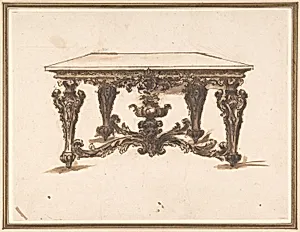
Design for a Table with Ornate Legs
17th century
Medium
Pen and brown ink, brush and brown wash, over graphite underdrawing
Dimensions
sheet: 7 1/16 x 9 3/16 in. (18 x 23.4 cm)
Classification
Drawings
Department
Drawings and Prints
Museum
Metropolitan Museum of Art, New York, NY
Credit
The Elisha Whittelsey Collection, The Elisha Whittelsey Fund
Accession Number
68.693
Rights
Public Domain
Tags
Art Historical Context
This delicate drawing, titled *Design for a Table withnate Legs*, captures the of 17th-century craftsmanship. Created anonymously by an Italian artist during the Baroque era, it presents a preparatory sketch for a luxurious table featuring intricately carved legs—likely adorned with scrolling motifs and dynamic forms typical of the period's exuberant style. Such designs were essential blueprints for master cabinetmakers, bridging the gap between artistic vision and opulent furniture destined for palaces and villas. Executed on a modest sheet measuring 7 1/16 x 9 3/16 inches, the work employs a sophisticated mixed-media technique: a precise graphite underdrawing provides the foundational structure, refined by fluid pen lines in brown ink and deepened with brush-applied brown wash for shading and volume. This method, common in Renaissance and Baroque draftsmanship, allowed artists to convey three-dimensionality and texture on paper, simulating wood grain and shadow play to guide sculptors and carvers. Housed in the Metropolitan Museum of Art's Elisha Whittelsey Collection, this anonymous gem highlights Italy's pivotal role in European design during the 1600s, when furniture evolved into sculptural art forms symbolizing wealth and status. Visitors can appreciate how such drawings fueled the grandeur of the Baroque interior, blending functionality with theatrical flair.